
Key Takeaways:
- Hyper-personalization transforms customer data into meaningful and engaging experiences.
- Customer-centric strategies help organizations improve satisfaction, retention, and growth.
Introduction:
Every day, consumers wade through hundreds of marketing messages, banner ads, sponsored posts, push notifications, and promotional emails. Most of them get ignored. Campaigns that treat everyone the same have become background noise, and brands that still rely on them are feeling the effects. What customers actually want is straightforward; they want to feel like a brand knows them.
That shift in expectation has given rise to hyper-personalization, an approach that goes well beyond addressing someone by first name in a subject line. It pulls from real-time behavioural data, individual browsing and purchase history, and emerging technologies to shape interactions that feel genuinely relevant. The gap between this and traditional personalization is significant, and businesses that grasp the difference are finding meaningful competitive advantages.
Benefits and Application:
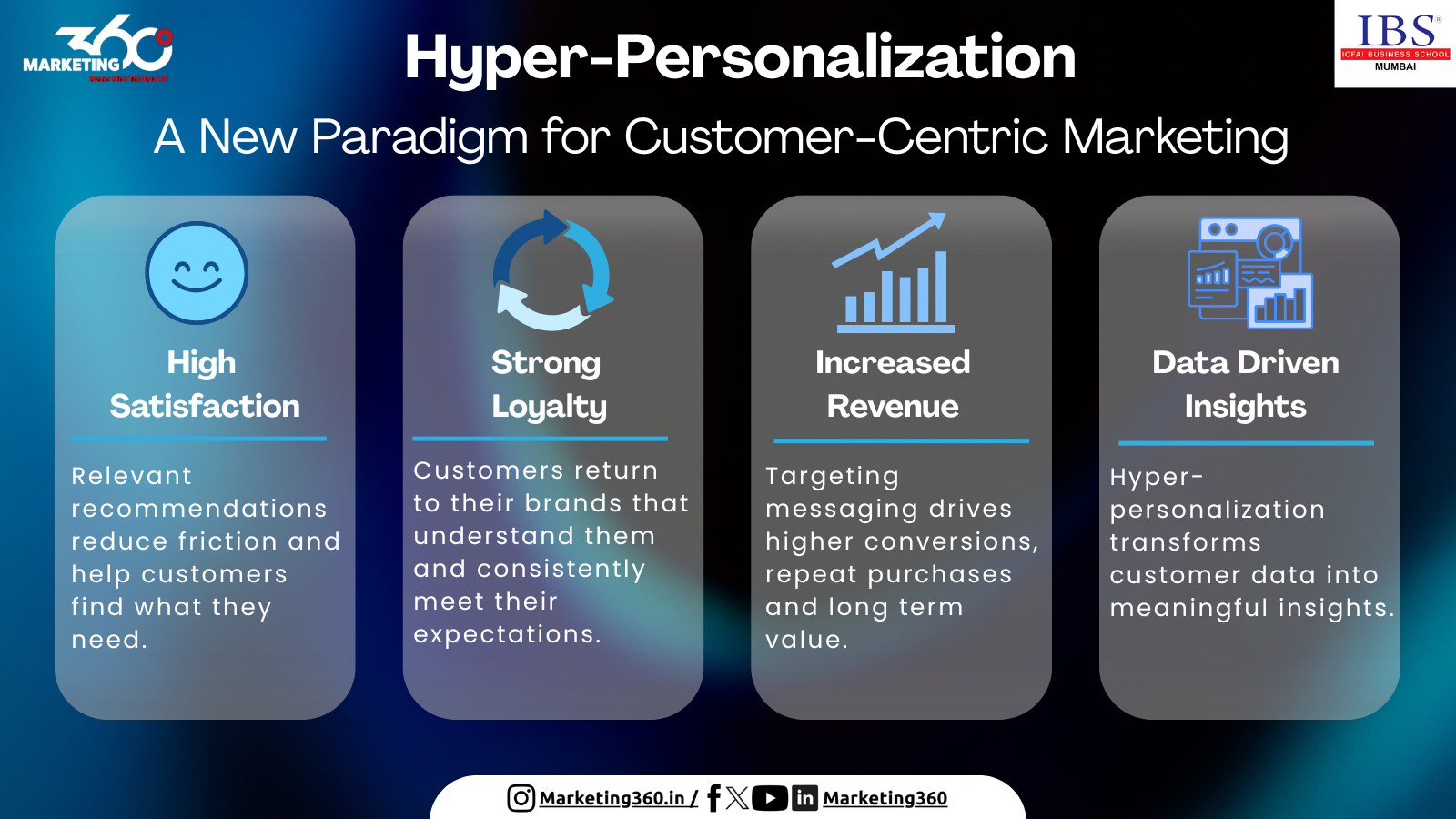
The most immediate payoff from hyper-personalization tends to be a measurable lift in customer satisfaction. When someone arrives on a product page and the first options shown genuinely reflect what they’ve been looking for, friction drops. Fewer irrelevant choices mean faster decisions and a noticeably better experience.
Loyalty tends to follow from that. People come back to brands that seem to get them. They also spend more; targeted messaging consistently outperforms generic campaigns, and the conversion gap widens as personalization becomes more precise. Repeat purchases increase, and long-term customer value climbs.
Amazon is probably the most recognizable case study here. Their recommendation engine tracks browsing history, purchase patterns, and product comparisons to surface items that genuinely make sense for each user. A substantial portion of the company’s revenue flows directly through those recommendations, not by accident, but because the system earns its usefulness.
Spotify takes a different route to the same outcome. By analyzing listening behaviour in detail – not just broad genre preferences but also skipping patterns, time-of-day habits, and mood-based tendencies – they build playlists like Discover Weekly and Daily Mix that consistently surface music users didn’t realize they’d enjoy. Engagement on those playlists sits well above platform averages, and they’ve become a central reason users stay subscribed.
Both examples point to the same underlying principle: when data is put to work thoughtfully, it produces experiences that stop feeling like marketing and start feeling like genuine service.
Hyper-Personalization and Customer-Centric Marketing
For a long time, most marketing operated from the inside out. Companies decided what they wanted to push and then found audiences to push it toward. Customer-Centric Marketing inverted that logic. The starting point shifts to the customer: what do they actually need, what are they trying to accomplish, and how can the business genuinely help?
Hyper-personalization fits naturally into this framework to support customer-centric marketing. Tailoring an experience to each individual’s real behaviour and stated preferences rather than assumptions based on demographics produces a more authentic connection. Customers stop being segments and start being people.
Trust sits at the center of this approach. Personalized recommendations, targeted offers, and customized campaigns done well communicate to customers that a brand is paying attention. That feeling of being understood tends to translate into stronger loyalty and more consistent engagement. As expectations have continued to rise, businesses that haven’t woven these practices into their strategy are finding themselves at a growing disadvantage.
Challenges and Future Outlook:
None of this comes without real complications. Privacy is the most pressing one. Consumers are far more aware than they were a decade ago of how their information is being collected, analyzed, and monetized and far more sceptical about whether companies are handling it responsibly. Regulations like GDPR and CCPA have raised the stakes considerably, and public trust, once damaged, doesn’t come back quickly.
There’s also a subtler issue that tends to get less attention: the line between feeling relevant and feeling intrusive is thin. A well-timed recommendation reads like good service. The same recommendation, repeated too many times or surfaced in an unexpected channel, starts to feel like surveillance. Threading that needle requires human judgment, not just algorithmic efficiency.
Looking ahead, the tools underpinning hyper-personalization are advancing steadily. AI systems are becoming more capable of anticipating customer needs before those needs are explicitly expressed. Real-time personalization across multiple channels – web, mobile, email, and in-store is now achievable without prohibitive technical complexity. Organizations that invest in these capabilities now, while keeping ethics and transparency at the center of the strategy, are building something competitors will find difficult to replicate later.
Conclusion:
Marketing has always been about relevance reaching the right person with the right message at the right moment. What’s changed is how accurately that’s now achievable. Hyper-Personalization, applied with care, moves the needle on engagement, loyalty, and revenue in ways that broad campaigns simply can’t.
The connection to Customer-Centric Marketing is what keeps this grounded. Data and technology are the instruments, but the underlying objective is to serve each customer’s actual needs rather than simply extract value from them. Brands that keep that distinction clear and that build trust through transparency rather than erode it through overreach are the ones constructing something durable. As the capabilities continue to improve, that foundation will matter more, not less.
External Link: https://bit.ly/4xgu4LQ

Umang Mehta
Content Writer

Tanmay Deshpande
Graphic Designer

Lysandra Monteiro
Content Editor