
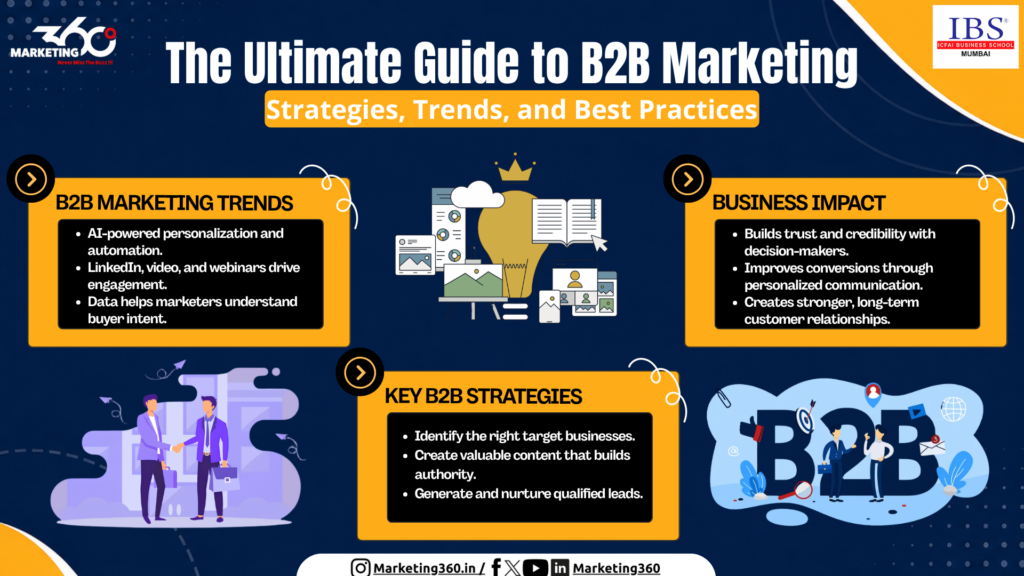
Key Takeaways:
- Understand key differences between B2B and B2C marketing and the importance of relationships.
- Explore modern B2B strategies and trends to generate leads and boost conversions.
Introduction
Imagine selling enterprise software worth ₹20 lakhs. Unlike a consumer purchase which can happen within minutes, the decision may involve multiple stakeholders, extensive research, budget approvals, demonstrations, and several rounds of discussion. This is where B2B Marketing plays a crucial role. Business-to-Business (B2B) Marketing is the process of promoting products or services from one business to another. Instead of targeting individual consumers, B2B marketers focus on decision-makers such as CEOs, procurement managers, marketing heads, and business owners. The objective goes beyond making a single sale. Effective B2B Marketing focuses on building trust, demonstrating value, and developing long-term business relationships. As buying journeys become increasingly digital and research-driven, businesses must combine valuable content, personalized communication, data-driven insights, and strategic digital channels to influence buyers at every stage.
Why Is B2B Marketing Important Today?
B2B buyers no longer depend entirely on sales representatives for information. They research solutions online, compare competitors, read reviews, download reports, and evaluate alternatives before initiating a conversation with a salesperson. This has transformed the modern B2B buying journey.
- A strong B2B Marketing strategy can help businesses
- Generate qualified leads
- Build brand credibility and industry authority
- Shorten the sales cycle
- Improve customer retention
- Increase revenue and customer lifetime value
Digital channels such as LinkedIn, SEO, email marketing, webinars, and marketing automation have become essential for reaching and nurturing business buyers. Instead of immediately pushing a product, successful marketers educate prospects, solve their problems, and build trust until they are ready to buy.
Understanding the B2B Marketing Process
1. Identify the Target Audience
Every effective B2B campaign begins with a clear understanding of its Ideal Customer Profile (ICP). Businesses analyze factors such as:
- Industry and company size
- Revenue and location
- Job role and decision-making authority
- Business challenges and requirements
A clearly defined audience allows marketers to focus their resources on prospects who are most likely to become valuable customers.
2. Build Authority Through Content
In B2B Marketing, expertise builds credibility. Businesses use content such as blogs, whitepapers, case studies, webinars, industry reports, and e-books to educate potential customers.
Rather than simply promoting a product, valuable content answers customer questions and demonstrates how a business can solve real problems. This establishes authority while supporting organic lead generation.
3. Generate Quality Leads
Lead generation is a key objective of B2B Marketing. Common channels include:
- LinkedIn Marketing
- SEO and Google Ads
- Email campaigns
- Webinars and industry events
- Referral programs
- Gated content and lead magnets
The focus should not be on generating the highest number of leads, but on attracting qualified prospects who match the company’s ICP.
5. Build Relationships and Retain Customers
In B2B, closing a deal is the beginning of the relationship not the end. Strong customer support, regular communication, feedback, upselling opportunities, and proactive account management can improve retention and encourage repeat business. Long-term relationships can also generate valuable referrals.
Latest Trends in B2B Marketing
1. AI-Powered Marketing
Artificial Intelligence is transforming B2B Marketing by enabling personalization, predictive analytics, automated communication, customer segmentation, and faster data analysis. AI-powered chatbots and intelligent automation help marketers improve efficiency while delivering more relevant customer experiences.
2. Account-Based Marketing (ABM)
Account-Based Marketing focuses on a specific group of high-value accounts rather than a broad audience. Marketing and sales teams collaborate to create personalized campaigns for individual organizations. This targeted approach can improve engagement, strengthen relationships, and increase conversion opportunities.
3. Video Marketing
Complex B2B products are often easier to understand through demonstrations, tutorials, webinars, and customer testimonials. Video helps simplify technical concepts while making content more engaging and accessible.
4. LinkedIn Marketing
LinkedIn has become a major B2B platform for professional networking, thought leadership, lead generation, and targeted advertising. Businesses can use it to connect with decision-makers while showcasing industry expertise and building credibility.
5. Marketing Automation
Automation simplifies repetitive activities such as email workflows, lead scoring, customer segmentation, CRM updates, and campaign tracking. This enables marketers to deliver personalized communication at scale while improving operational efficiency.
Why Does B2B Marketing Work?
The effectiveness of B2B Marketing comes from its ability to address business problems rather than simply promote products.
Business buyers typically evaluate factors such as:
- Return on Investment (ROI)
- Cost savings
- Operational efficiency
- Reliability
- Expertise
- Long-term support
Since B2B purchases involve higher investments and multiple stakeholders, buyers need evidence and confidence before committing. Businesses that provide useful insights, demonstrate measurable results, and communicate transparently are more likely to build lasting customer relationships.
Real-World Examples
Several global companies demonstrate the power of effective B2B Marketing:
- HubSpot attracts businesses through educational content, free tools, certifications, and inbound marketing resources.
- Salesforce uses webinars, customer success stories, and personalized demonstrations to engage enterprise buyers.
- Adobe leverages case studies, industry insights, and solutions tailored to different business needs.
- LinkedIn enables businesses to reach professional audiences through networking, sponsored content, and targeted advertising.
These examples highlight three powerful principles: valuable content, personalization, and relationship-building.
Best Practices for Effective B2B Marketing
Businesses can strengthen their B2B Marketing efforts by:
- Focusing on customer problems rather than product features
- Creating valuable and educational content consistently
- Aligning marketing and sales teams
- Personalizing communication across the buyer journey
- Using CRM and automation tools effectively
- Measuring campaign performance through analytics
- Continuously testing and optimizing campaigns
- Prioritizing long-term relationships over quick sales
Conclusion
In a competitive business environment, B2B Marketing is no longer just about selling products. It is about building trust, demonstrating value, solving business problems, and creating lasting partnerships. From content marketing and LinkedIn networking to Account-Based Marketing and AI-powered automation, modern B2B strategies combine technology with genuine customer understanding. Ultimately, successful B2B Marketing comes down to one principle: understand what businesses need, deliver measurable value, and build relationships that grow over time.
External Link: https://bit.ly/4qAvuxP

Aastha Jain
Content writer

Dhruvi Chandel
Graphic designer

Vidhi Ravaria
Content Editor