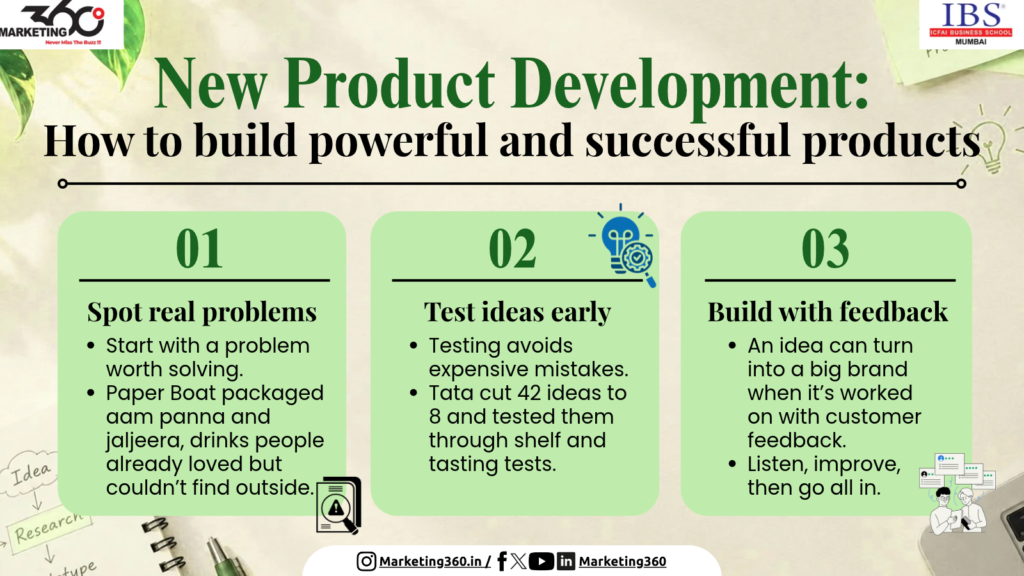
Successful products start by spotting real problems
Test ideas early to avoid expensive mistakes
An idea can turn into a big brand when worked on with feedback
Introduction:
Every brainstorming meeting generally starts with “ I have an idea.” Four words that can either start the next big thing or completely ruin a group project. Brands face the same problem, except their “let’s just try it” can cost millions. New Product Development is where that random idea takes its first real-world step and proves its worth. Is there a problem worth solving? Will people actually want the product? And will they care enough to buy it? One can have the greatest idea in the room, but if it’s not useful to the people in that room, it means nothing.
Taking you inside the mind of a real brand:
Enough of the textbookish jargon; now let’s take a real-life example of a New Product Development Strategy of a cute beverage brand known as Paper Boat. The brand did not start by thinking, “I am too lazy to drink water; now let’s just make juice”. They identified the common problem of Indian consumers, and the problem was much simpler. People already loved drinks like Aam panna and Jaljeera at home, but finding them outside of their home in a packaged form wasn’t easy. So Paper Boat first tested these products way back in February 2013 and then took the brand on a national level later that year. That’s a pretty simple way to look at product development strategy. Find something people already like, make it easier for them to get, test it, and scale it to the next level. Paper Boat did not try to create a new problem for its product. They found a problem that was already there and built around it.
An important plot twist you really wanna know:
But here comes another plot twist on our journey of building a powerful product development strategy: sometimes the first good idea just doesn’t work. Tata Consumer Products recently ran an innovation sprint where the team came up with 42 product ideas in just four days. Then they cut that list down to 8 ideas that seemed worth taking forward and tested them with actual customers through shelf and tasting tests, and that’s the important scene of our new product development journey. You might love an idea when you are sitting in a brainstorming room, but at the end of the day it’s the customer who decides whether the idea actually works.
A successful product is not really created in one drawing room. It is built by spotting a real problem, testing an idea, listening to customers and improving before going all in. The brands that get this right understand one simple thing: you don’t build products for customers; you build them with customers in mind. Because sometimes the idea that sounds the coolest may get flopped in the real world, but a random product idea makes a customer say, “Finally, someone solved this”. And that turns a simple idea into something people actually want, use and remember.