Price speaks to the product itself and does more than just determine profits. Price will determine quality for consumers; too low can be interpreted as “cheap,” but too high can turn them off. A company can balance these factors, attract its target market, and compete successfully with pricing strategies.
Effective Pricing Techniques:
Different situations call for different approaches to pricing. Some of the most widely used ones by businesses today are listed below:
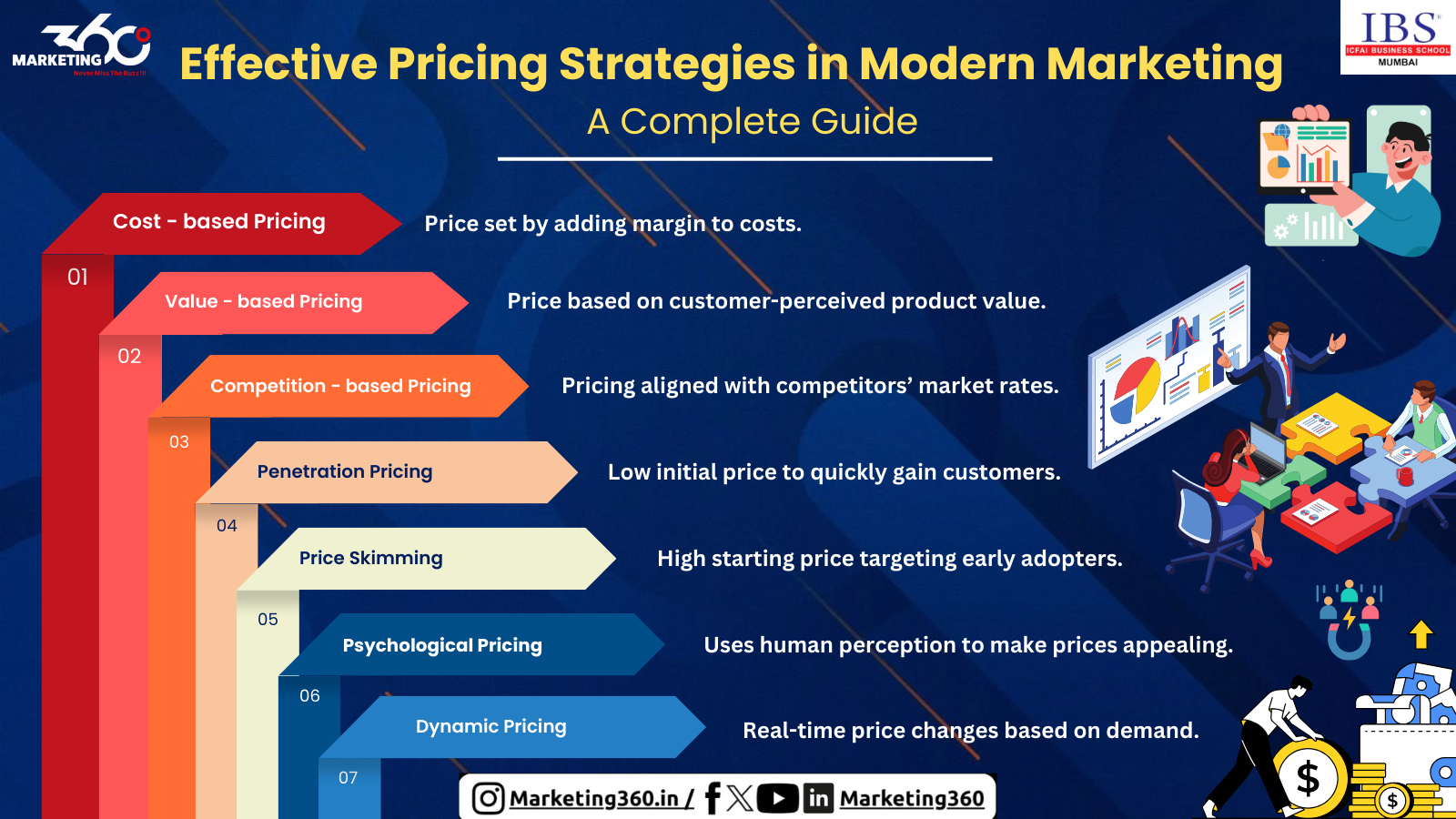
Cost-based pricing: Calculate the product’s production costs and add a profit margin. It may not always be the amount that customers will pay, even though it covers costs.
Value-Based Pricing: In this case, the customer’s perception of the product’s value is taken into consideration. Businesses like Apple use this tactic by setting prices based on perceived value, experience, and innovation rather than production costs.
Competition-Based Pricing: Businesses often take into account what their rivals charge and set their prices accordingly when there is market competition. They become more competitive as a result, but it can also lead to a price war in which all parties lower their prices.
Pricing for Penetration: Some businesses set an initial low price when launching a new product in order to quickly acquire clients and build a clientele. Prices are gradually increased as soon as they gain their trust.
Price Skimming: The opposite of penetration pricing is price skimming. Businesses set their prices high to attract early adopters, then progressively lower them to attract more clients. It is frequently used for high-end products or new technology.
Psychological Pricing: This strategy takes advantage of human psychology by making a ₹999 price tag appear lower than a ₹1000 one, even though the difference is minimal. Purchase behaviour can be significantly impacted by such small tactics.
Dynamic Pricing: Companies can now adjust prices in real time based on competition and demand, thanks to data and technology. This tactic is used by taxi services, internet retailers, and airlines to stay flexible and make the most money.
There is no universal strategy for pricing; it varies according to factors such as competition, customer preferences, and the product’s lifecycle. More developed brands commonly apply value-based pricing techniques to keep their high-quality image, while newcomers might take the route of lower prices to gain visibility. Nevertheless, arriving at the correct price is not an easy task since changing consumer tastes, increasing expenses, or macro-economic shifts could push companies to review and possibly change their plans. Higher prices are a direct invitation to lose customers, whereas low prices could lead either to a decrease in profits or to a bad image for the brand. Hence, the practice of monitoring and regularly updating pricing strategies that rely on market input is common among the most effective marketers.
Conclusion:
Fundamentally, pricing is both an art and a science. In addition to understanding the numbers, it entails analysing the emotions and driving forces behind a purchase. In modern marketing, good pricing not only boosts revenue; it also builds brand identity, fosters trust, and ensures long-term success in a cutthroat industry. If you own a small-scale business, what would be your pricing strategies to improve your brand recognition? Let us know your thoughts in the comment box below.