A Complete Guide to Different Types of Market Research

A Complete Guide to Different Types of Market Research

Key Takeaways:

  • Know the different types of market research and how they can be used.
  • Elevate your business decisions by choosing the right research methodology.

Introduction

In a competitive business environment, knowledge of your customers, your competitors, and the changing trends in the market is essential for making informed decisions. Market research is a method companies can use to collect and analyze relevant data about their target market and industry. It helps companies to understand customer needs, assess opportunities, mitigate risks and develop strategies that are better aligned with market expectations.

What is Market Research?

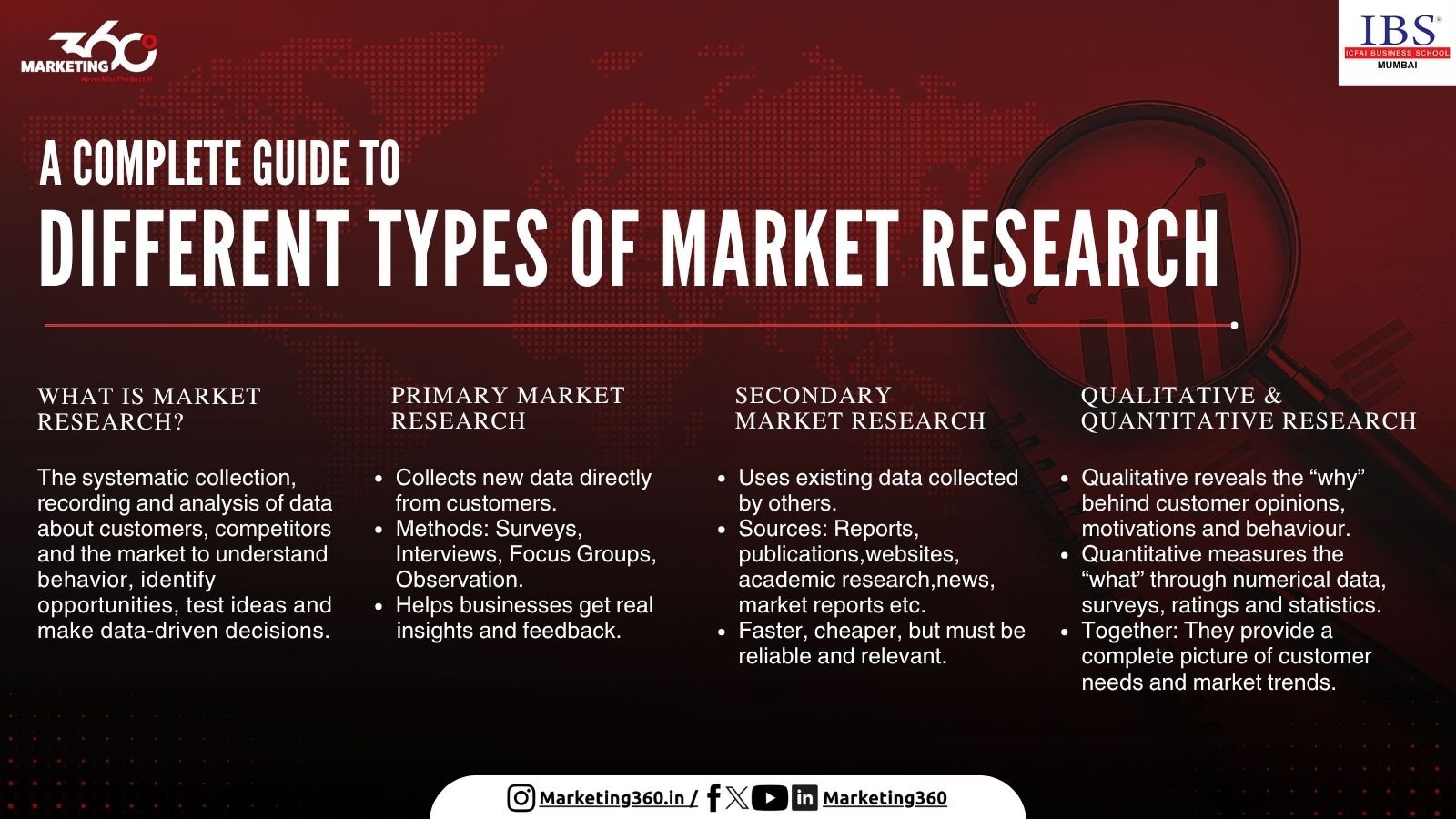
Market Research is the process of gathering, recording and analyzing information about customers, competitors and the market. Companies use this information to understand consumer behavior, find opportunities, test ideas and make data-driven decisions. Research can be classified in many ways depending upon its purpose, source of information and the type of data to be collected.

Market Research Types

1. Primary Market Research:

Primary market research is when you gather information that is new directly from customers or other respondents that is relevant. The information is collected for a business purpose.

Different methods include:
Surveys: Collecting responses from a large group of people
Interviews: Having deep conversations to get people’s perspectives.
Focus Groups: Bringing together a small group of people to discuss a product, service or idea.
Observation – Watching customers in the real world.

For example, a company that is about to launch a new drink might ask potential customers about what flavors, price and packaging they would like.

2. Secondary Market Research

Secondary research is the use of information that has already been collected by other organizations or for other purposes. These can be government reports, industry publications, company websites, academic research, newspapers, market reports etc. It is usually faster and cheaper than gathering new information. But businesses need to assess if the data they hold is reliable, relevant and current.

3. Qualitative Research

Qualitative research is used to understand people’s views, motivations, experiences and attitudes. It’s looking at why customers do what they do, not just the numbers. This kind of research often uses interviews, focus groups and open-ended questions. This can be especially useful for businesses trying to figure out why customers think or act in a certain way.

4. Quantitative Research

Quantitative research is measurable and numerical data. Which include multiple choice surveys, sales figures, customer ratings and statistical analysis. This allows companies to see trends, measure preferences, break down customer segments and make decisions based on data.

What are the various types of research important?

A good choice of the research approach allows businesses to collect data that is relevant to their particular goals. Market research helps companies to identify gaps in the market, assess competitors, understand customer expectations and reduce uncertainty before making crucial decisions. For example, a business might use secondary research to learn about an industry, and then follow up with primary market research to get direct feedback from customers.

Conclusion

Different research methods offer different perspectives for businesses. Primary and secondary methods can be used separately or simultaneously depending on the research purpose. This allows companies to choose the right approach and analyze the information carefully, leading to more informed decisions and effective responses to changing customer needs. Therefore, market research is an important tool for companies to get to know about their environment and develop strategies based on real knowledge of customers and the market.

Umang Mehta

Content writer

Vineet Panchal

Graphic designer

Lysandra Monteiro

Content Editor 

Leave a Comment

Your email address will not be published. Required fields are marked *