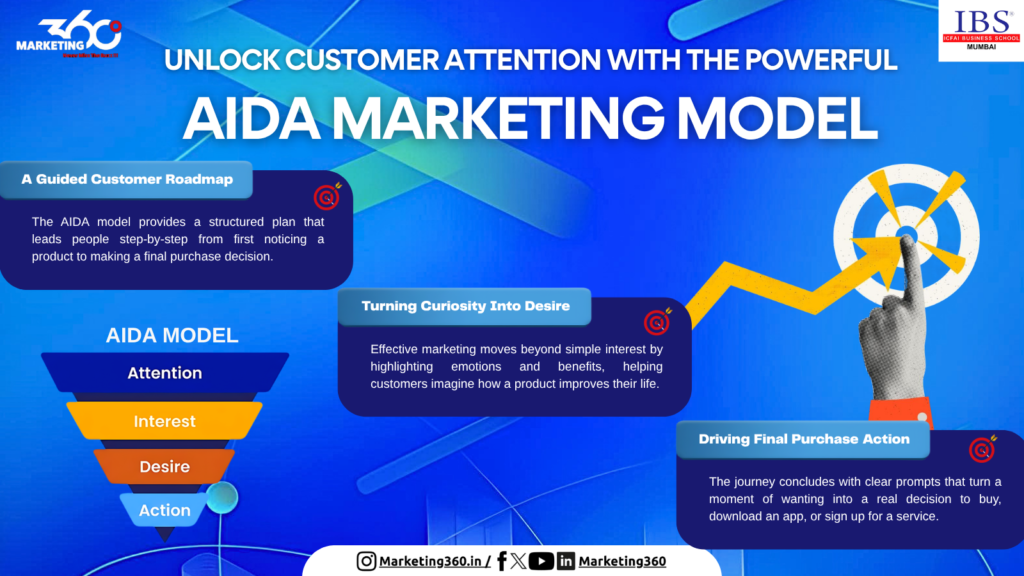
A simple model explaining how customers move from noticing a brand to buying.
Helps businesses guide customers step-by-step towards purchase decisions.
Introduction:
Imagine, you are walking in a market with your parents. Suddenly, you see a bright red balloon shop. The colors catch your eye, the balloons look fun, and you start thinking, “I want one!” Soon you ask your parents to buy it. That small journey from seeing the balloon to wanting it is exactly how marketing works. Brands don’t randomly show advertisements. They follow simple steps that slowly move people from not noticing a product at all to wanting to buy it. One popular way marketers understand this process is through the AIDA Marketing Model.
Why It Is Important Today:
Today, people see thousands of advertisements every day on social media, websites, billboards, and within mobile apps. Because of this, brands cannot simply show a product and expect people to buy it. Instead, businesses need a clear plan to guide customers through the buying process. The AIDA Marketing Model provides a structured roadmap for understanding the customer buying journey before making a purchase decision. It helps marketers move people step-by-step from discovering a product to eventually choosing it. Think of it like a small journey every customer experiences before making a purchase.
Understanding the Process:
Attention – “Look at me!” The first step is getting people to notice you. Imagine a toy store placing a giant teddy bear outside its entrance. Children walking by immediately stop and look at it. That moment of noticing something is the starting point. Brands often use bright colors, strong headlines, engaging videos, or trending posts to make people pause and look. If people do not notice a brand, the rest of the journey cannot begin.
Interest – “Tell me more!” After noticing something, people often become curious. For example, once you see the giant teddy bear outside the shop, you may walk closer to see what other toys are available. Now curiosity begins to grow. Businesses create interest by showing features, explaining benefits, and sharing stories that help people understand why the product is useful or enjoyable.
Desire – “I want this!” Interest slowly turns into wanting something. At this stage, you are not just looking at the toy anymore. You start imagining how exciting it would be to take it home. Companies build this feeling by highlighting emotions, comfort, enjoyment, or convenience connected to their product. This helps people picture themselves using it.
Action – “Let’s buy it!” The final stage is action. This is when you finally say to your parents, “Can we buy this toy?” In marketing, action can include: • Buying a product • Clicking a link • Downloading an app • Signing up for a service Businesses often include prompts such as “Buy Now, Order Today, or Shop the Collection” to encourage customers to take the final step.
Why This Model Works So Well
This approach works because it reflects how people naturally make decisions. Customers rarely purchase something instantly. Most people move through a simple process: 1. They notice something 2. They become curious about it 3. They start wanting it 4. They finally decide to buy it Organizing this natural behavior into a structured process helps businesses communicate more effectively with potential customers.
Marketing may seem complicated, but many powerful ideas are actually very simple. By guiding people step-by-step from curiosity to decision, businesses can turn a small moment of interest into a real purchase by using the AIDA marketing model. Just like a child spotting a colorful balloon in a busy market, every customer buying journey begins with a moment of attention. When brands guide that journey thoughtfully, it often leads to satisfied customers and successful businesses.