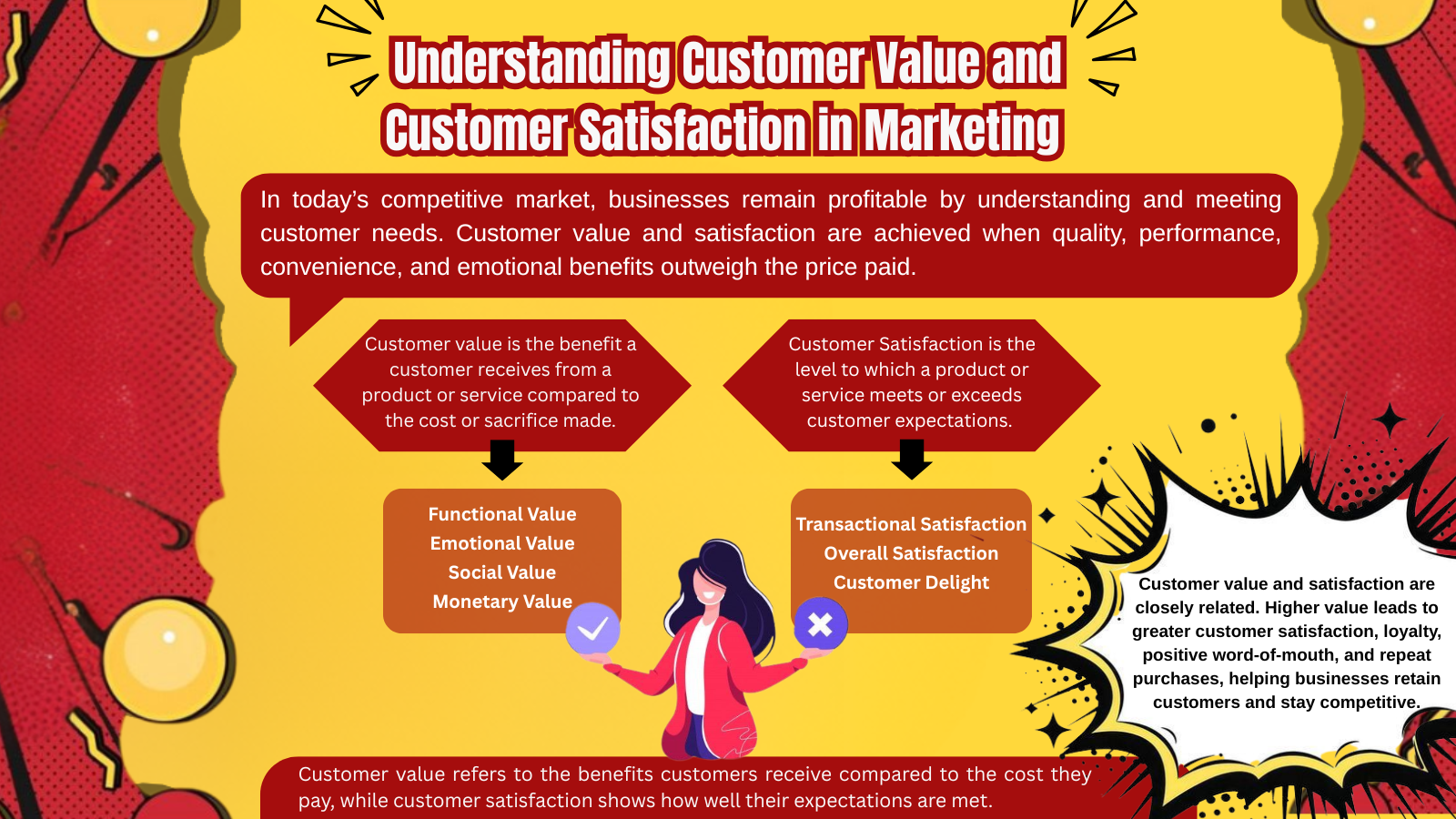
Customer value is the benefit that customers feel compared to the price they pay.
Customer Satisfaction comes from meeting or exceeding customer expectations.
Introduction:
In today’s competitive market, a business can stay profitable only when it truly understands customer needs and works to meet them. Customer value and satisfaction play a crucial role in this process by focusing on delivering the right benefits and creating a positive experience with the product or service. Customers feel satisfied when factors such as quality, performance, convenience, and emotional satisfaction clearly outweigh the price they pay.
Customer Value :
Customer value is a measure of the advantages delivered to a customer by a service or product, compared to the different types of costs. Customer value can be defined as the evaluation of the customer’s benefits obtained from the product or service in comparison with the sacrifice made.
Types of Customer Value :
Functional Value: This value is directly linked to the product’s performance and utility. Example: A washing machine that not only cleans clothes effectively but also saves water yields high functional value.
Emotional Value: The value that is associated with the customer’s feelings or emotions when using the product is known as emotional value. Example: Acquiring a luxury watch that makes the customer feel self-confident and prestigious.
Social Value: Social value is the value a customer derives from using a product that makes them more socially accepted or admired. Example: Usage of a high-end smartphone brand that is the envy of one’s friends.
Monetary Value: This is the value that one gets for his/her money or the amount of money one can save in the process. Example: Price cuts, cashbacks, and pricing that is relatively cheaper than competitors.
Customer Satisfaction
Customer Satisfaction is a metric that shows the level to which a product or service meets and even surpasses a customer’s initially set expectations. Customer satisfaction is a company’s indicator of overall customer happiness regarding their products, services, and experiences. If the real performance is equal to the set expectations, the customers are satisfied. The customers will be deluded if the performance is better than the expectation, and dissatisfied if the performance is less than the expectation.
Types of Customer Satisfaction:
Transactional Satisfaction: It is the satisfaction that one gets from a single purchase or interaction. Example: The fast delivery of an online order makes a customer happy.
Overall Satisfaction: It is the reflection of a customer’s deep background with a brand. Example: Due to the steady quality of the services, a customer remains loyal to the same bank.
Delight: The delight of customers is the result of the company’s one-upmanship of their expectations. Example: Receiving a free upgrade or complimentary service.
Relationship Between Customer Value and Satisfaction:
Customer value and satisfaction have a very close relationship. When a customer is given a lot of value, they will undeniably be satisfied with the product. As a result, customer loyalty will be fostered among other positive consequences, such as positive word-of-mouth and repeat purchases. Businesses that can systematically provide high value to their customers will be more successful in terms of retaining customers and gaining a competitive edge.
Conclusion:
Customer value and Customer satisfaction are the two keys that lead to business success. The first one accentuates the benefits-to-costs ratio while the second one is a measure of how well customer expectations are fulfilled. Companies that intend to grow in the long run are the ones that will deliver high Customer value along with customer satisfaction. These companies will also be able to develop strong customer relationships and will get brand recognition and loyalty.